My most recent experience in research was through working as a University Lecturer. Prior to that, I held a number of different research roles including time where I worked as a Research Assistant on a multicentre clinical trial, as a Research Associate for a mindfulness-based charity (Breathworks Manchester), and I have completed two doctoral-level research projects.
Most of my research experience and publications have been on projects exploring mindfulness-based interventions for people who have long-standing difficulties with depression.
I have published a number of peer-reviewed articles on this topic (see the list including links to the publications below).
I believe in the importance of research in Clinical Psychology in order to maintain an evidence-base for the therapeutic models and approaches that we use.
I have enjoyed working in research and am proud of the work I have carried out, and the results published in the articles below.
- Williams, K. & Marchant, L. (in preparation). A mixed-method exploration of the need for clinical supervision of mental health researchers.
- Anderson, I. M., & Williams-Markey, K. (2024). Clinical features of depressive disorders. In D. Kingdon, P. Rowlands, & G. Stein (Eds.) Seminars in General Adult Psychiatry. Royal College of Psychiatry
- Williams, K., Hartley, S., Langer, S., Manandhar, M., & Taylor, P. (2022). A systematic review and meta-ethnographic synthesis of Mindfulness-based Cognitive Therapy (MBCT) for people with depression. Clinical Psychology and Psychotherapy, EPub, 1-21. https://doi.org/10.1002/cpp.2773
- Williams, K., Hartley, S., & Taylor, P. (2021). A Delphi study investigating clinicians’ views on access to, delivery of, and adaptations of MBCT in UK clinical settings. Mindfulness, 12(9), 2311-2324
- Williams, K., Hartley, S., Anderson, I. M., Birtwell, K., Elliott, R., Dowson, M., & Taylor, P. (2021). An ongoing process of reconnection. A qualitative exploration of Mindfulness-based Cognitive Therapy for adults in remission from depression. Psychology and Psychotherapy: Theory, Research, and Practice (early online access first)
- Williams, K., Elliott, R., Barnhofer, T., Zahn, R., & Anderson, I. M. (2021). Positive shifts in emotion evaluation following mindfulness-based cognitive therapy (MBCT) in remitted depressed participants, Mindfulness, 12, 623-635 https://doi-org.manchester.idm.oclc.org/10.1007/s12671-020-01521-4
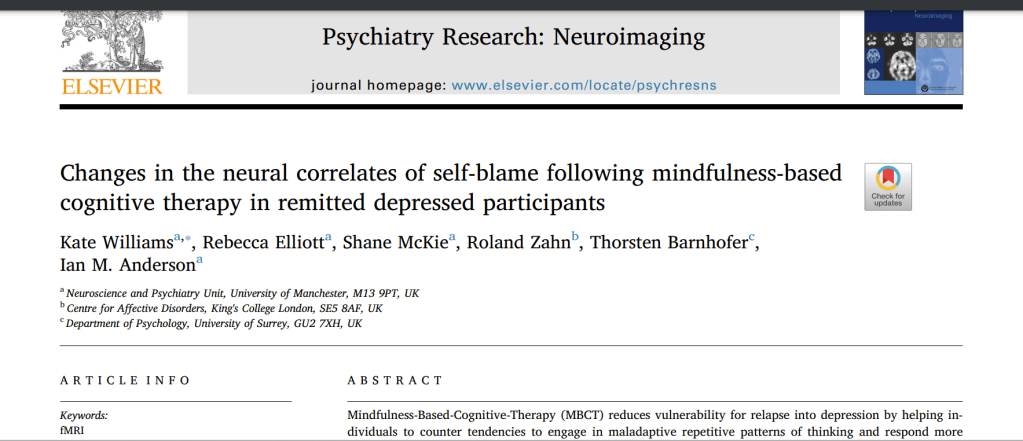
- Williams, K., Elliott, R., McKie, S., Zahn, R., Barnhofer, T., & Anderson, I. M. (2020). Changes in the neural correlates of self-blame following mindfulness-based cognitive therapy in remitted depressed participants. Psychiatry Research: Neuroimaging, 304, 111152 https://doi.org/10.1016/j.pscychresns.2020.111152
- Williams, K. & Birtwell, K. (2018). The double-edged sword of mindfulness. Maintaining integrity whilst increasing access. Clinical Psychology Forum, 306
- Birtwell, K., Williams, K., van Marwijk, H., Armitage, C. J., & Sheffield, D. (2018). An exploration of formal and informal mindfulness practice and associations with wellbeing. Mindfulness, 10, 89-99 https://doi.org/10.1007/s12671-018-0951-y
- Williams, K. (2015). Are we mindful of how we talk about mindfulness? The Psychologist, 28, 216 – 217 https://thepsychologist.bps.org.uk/volume-28/march-2015/new-voices-are-we-mindful-how-we-talk-about-mindfulness
- Williams, K. & Anderson, I. M. (2014). Psychotherapy for depression. A review and practical guide. Prescriber, 25, 10-16 https://doi.org/10.1002/psb.1260
- Williams, K., Thomas, E., Arnone, D., Elliott, R., Deakin, J. F. W., Williams, S., McKie, S., & Anderson, I.M. (2014). Impaired face emotion recognition in depression: The influence of pharmacological and psychological factors. European Neuropsychopharmacology, 24(S2), S388
- Calogero, R. M., Park, L., Rahemtulla, Z., & Williams, K. C. D. (2010). Predicting excessive body image concerns among British university students: The unique role of appearance-based rejection sensitivity. Body Image, 7, 78 – 81 https://doi.org/10.1016/j.bodyim.2009.09.005
- Williams, K. (2015). The emotional side of carrying out a PhD. In E. Norris (Ed.), PsyPAG: A guide for psychology postgraduates: Surviving postgraduate study (pp 31-34).Leicester, BPS.
- Williams, K. (2015). Where are they now? Discussion paper. The PsyPAG Quarterly, 95, 18-25 http://www.psypag.co.uk/wp-content/uploads/2013/06/Issue-95.pdf
- Williams, K. (2015). [A review of the book Effortless Mindfulness. Genuine mental health through awakened presence, by L. D. Miller]. Social Psychological Review, 17(1), 26-28
- McAllister-Williams, R. H., Anderson, I. M., Finkelmeyer, A., Gallagher, P., Grunze, H. C. R., Haddad, P. M., Hughes, T., Lloyd, A. J., Mamasoula, C., McColl, E., Pearce, S., Siddiqi, N., Sinha, B., Steen, N., Wainwright, J., Winter, F. H., Ferrier, N., Watson, S., & the ADD Study Team. (2016). Antidepressant augmentation with metyrapone for treatment-resistant depression (the ADD study): a double-blind, randomised, placebo-controlled trial. Lancet Psychiatry, 3(2), 117-127. DOI: 10.1016/S2215-0366(15)00436-8. (Member of “the ADD study team”).
 Dr Kate Williams-Markey, Clinical Psychology Services